How AI perimeter fencing stops intruders before they reach the door
A virtual fence is a line you draw on a camera view, not a thing you build on the ground. Here is what it is really doing, why it does not fire at every raccoon, and what happens in the seconds after someone steps over it.
Most commercial break-ins are not sophisticated. Someone walks a fence line at 2 a.m., finds the gap everybody on site already knows about, and is inside in under a minute. The cameras record all of it faithfully - and nobody watches the footage until the next morning, when the copper is gone.
Perimeter fencing flips that order. Instead of recording an incident for review, the system is watching the boundary in real time and raising a human the moment it is crossed. The word "fencing" is doing metaphorical work here: nothing is built, nothing is buried, and no one digs a trench.
What a virtual fence actually is
On a camera's field of view, we draw a polygon - usually along the real property line, the inside face of a gate, or a few metres in from the chain link so there is reaction time. That shape is stored as a rule: if a person or a vehicle crosses this line, in this direction, during these hours, raise an alert.
Three parts of that sentence do the heavy lifting:
- Person or vehicle. The analytics classify what crossed before deciding anything. A cat, a branch, a plastic bag and a shift in shadow are all objects in motion; none of them are the two classes the rule cares about.
- In this direction. A directional line ignores staff walking out to the parking lot and fires on anyone coming the other way.
- During these hours. A yard that is legitimately busy from 6 a.m. to 6 p.m. does not need the same rule at midnight. Schedules are why a working site can be armed at all.
Why it ignores the raccoon
Filtering is not one trick, it is four stacked on top of each other:
- Classification. The model labels the moving object. Anything that is not a person or vehicle never becomes an event.
- Size and perspective. A camera knows roughly how big a person should look at a given depth in the frame. An object the height of a cat, at a distance where a person would fill a third of the image, is discarded.
- Persistence. A crossing has to hold for a beat. Objects that appear and vanish between frames - insects lit by the IR ring, rain streaks - do not survive it.
- A human being. The last filter is an operator. The analytics decide what is worth a person's attention; the person decides what is worth a phone call.
That last one is the part that gets skipped in most product demos, and it is the one that matters. Detection without response is a notification you will eventually mute.
What happens in the seconds after a crossing
On a monitored site, the sequence runs roughly like this:
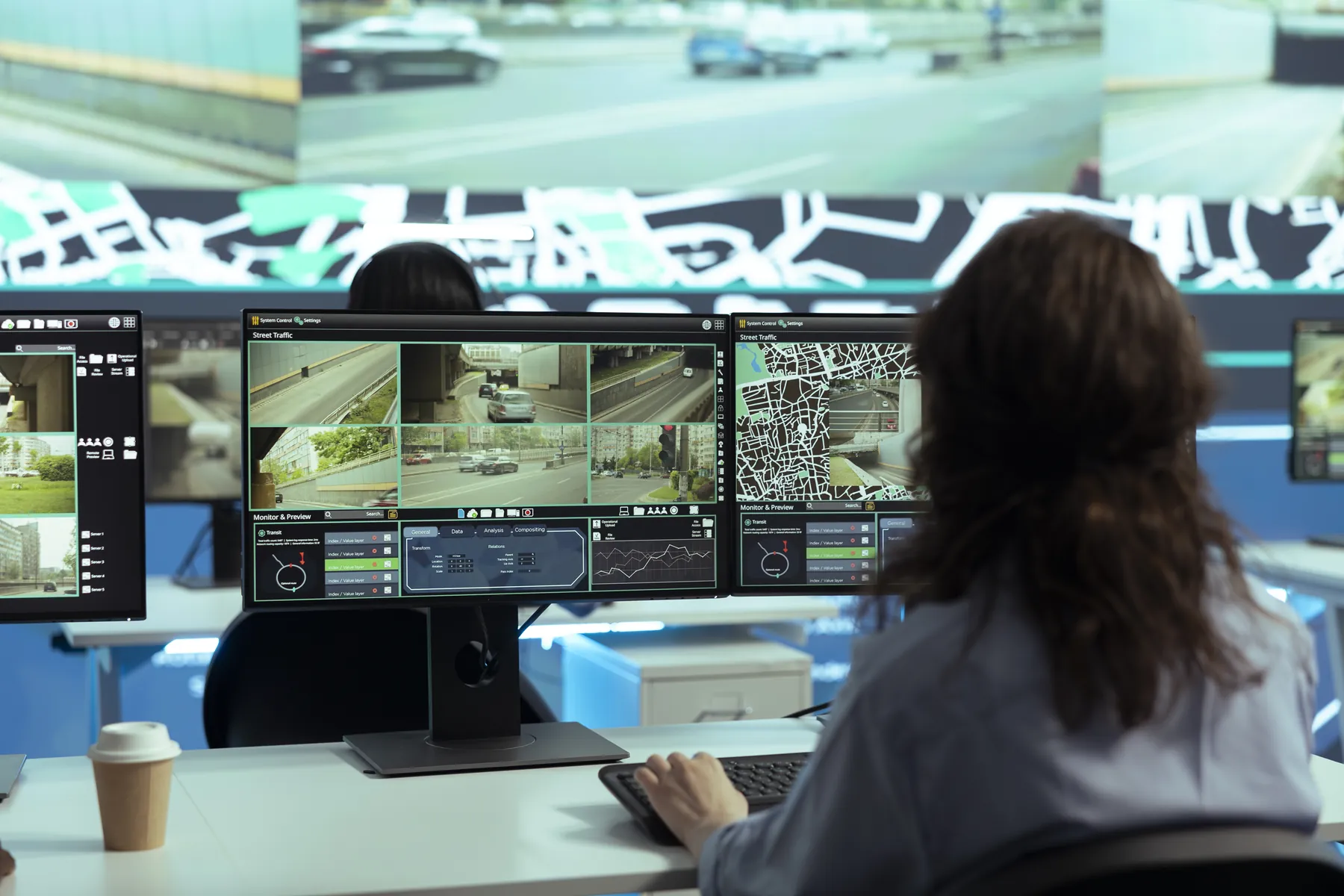
- The rule trips, and the relevant camera jumps to the top of an operator's screen with the clip that caused it.
- The operator confirms what they are looking at - a person on the wrong side of a line, at an hour when nobody should be there.
- A voice-down goes out over the on-site speaker. Not a siren: a live human describing what the person is wearing and where they are standing. A recording tells an intruder the site is automated; a voice that knows their jacket colour tells them they have been seen.
- If they leave, the incident is logged with the clip and closes there.
- If they do not, police are called with a verified crime in progress rather than an unverified alarm - a materially different call, and one that gets a materially different response.
The great majority of intrusions we handle end at the voice-down. People who are on a site to take something leave when a stranger starts narrating their movements.
Where the line should go
Getting value out of this depends almost entirely on where the boundary is drawn, and that is a site-walk decision, not a software one. A few rules of thumb from doing a lot of them:
- Push the line out, not in. A fence drawn at the building wall gives you a few seconds. One at the property edge gives you a minute - enough to speak to someone before they reach anything worth taking.
- Respect the public sidewalk. Lines that overlap a footpath or a neighbouring lot generate constant traffic and privacy problems. In Canada, keep detection on the property you control.
- Mind the light. A boundary that runs through the one unlit corner of a yard will underperform. Either move the line or fix the light - usually the light is cheaper.
- Cover the ways in, not the whole fence. Gates, laydown areas, the low spot in the fence and the neighbouring lot everyone cuts through are where the crossings happen.
The short version
- A virtual fence is a rule on a camera view: object class, direction, and schedule.
- Classification is what makes it usable - the alerts stay rare enough that people still read them.
- The response, not the detection, is what ends the incident.
- Where the line is drawn matters more than which camera you bought.
If you have cameras already, you may be closer to this than you think - perimeter rules run on most modern IP cameras, and the missing piece is usually the monitoring centre behind them rather than new hardware. A site walk will tell you which of the two you actually need.